
Lionel Messi: The Greatest Footballer of Our Time
SPORTFEATURED
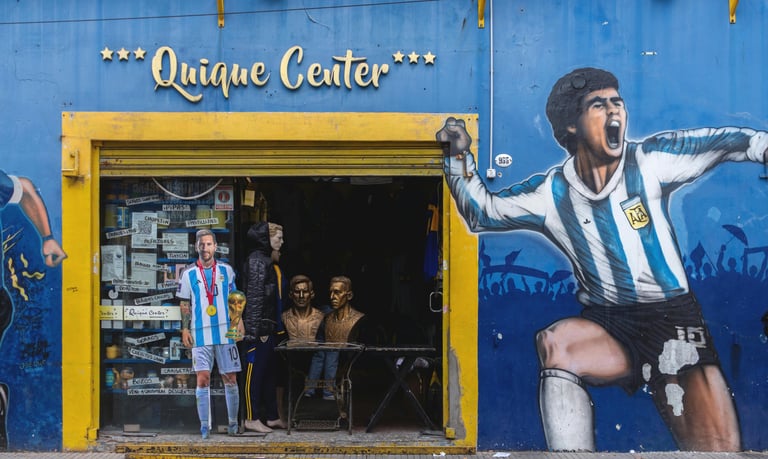
The Journey of a Legendary Champion
Lionel Andrés Messi stands as arguably the greatest footballer in history, a player whose extraordinary talent, dedication, and competitive spirit have reshaped the landscape of modern football. Born on June 24, 1987, in Rosario, Argentina, Messi has transcended the sport to become a global icon, captivating audiences across continents with his mesmerizing skills and unparalleled achievements. His career narrative is one of humble beginnings transformed into unprecedented success—a testament to the power of perseverance and exceptional talent.
From Rosario to Barcelona: The Early Years
Messi's footballing journey began in his hometown of Rosario, where he grew up in a tight-knit, working-class family. His father, Jorge Messi, worked in a steel factory, while his mother, Celia Cuccittini, was employed as a cleaner. Despite these modest circumstances, football dominated the family's life. Messi joined his first club, Grandoli, at just five years old—a local team coached by his father—and by age eight, he had progressed to Newell's Old Boys, one of Rosario's top-division clubs. His childhood years were marked by an extraordinary affinity for the beautiful game, playing alongside his older brothers and cousins.
However, at around age nine, Messi was diagnosed with a growth hormone deficiency, a condition that threatened his career aspirations. This diagnosis proved to be a pivotal moment in his life. Barcelona's recognition of his exceptional talent led the club to offer something remarkable: not only would they provide professional development, but they would also cover his medical treatment. At age thirteen, Messi and his family made the monumental decision to relocate to Spain. He joined La Masia, Barcelona's renowned youth academy, where he would begin his ascent to immortality.
Arriving in Barcelona, the shy and reserved Messi quickly impressed everyone with his close control, low center of gravity, and explosive speed. He made his competitive debut for Barcelona at age 17 in October 2004, becoming one of the youngest players to appear for the club. What followed was an era of unprecedented dominance.
The Barcelona Dynasty: Rewriting the Record Books
Messi's 17 years at FC Barcelona were nothing short of extraordinary. Between 2004 and 2021, he became the club's all-time leading goal scorer with an astounding 672 goals across 778 appearances in all competitions. This period witnessed a transformation of football itself, as Messi's artistry and goal-scoring prowess combined to create a playing style that defenders could rarely contain.
His individual achievements during his Barcelona years are staggering. Messi won eight Ballon d'Or awards—the highest accolade in football—establishing a record that remains unmatched. He won a record eight Pichichi Trophies (La Liga top scorer) and became La Liga's all-time leading goalscorer with 474 goals, a record that showcases his consistency and longevity. His goal-scoring records extended across European competitions; he won the UEFA Champions League Top Scorer award six times between 2008 and 2019.
One of Messi's most remarkable statistical achievements came in 2012, when he scored an astonishing 91 goals in a single calendar year—a Guinness World Record that stands as a testament to his productivity during that era. In the 2011-12 season alone, he set the European record for most goals in a season with 50 league goals, while accumulating 73 goals in all competitions, surpassing Gerd Müller's 67-goal record from the 1972-73 season.
Collectively, Barcelona under Messi's leadership won 10 La Liga championships, 7 Copa del Rey titles, 4 UEFA Champions Leagues, 7 Supercopa de Españas, 3 UEFA Super Cups, and 3 FIFA Club World Cups. These collective achievements underscore how Messi's excellence translated into tangible success for his team.
Playing Style: The Art of Perfection
What distinguishes Messi from other elite players is not merely his goal-scoring prowess, but the manner in which he achieves it. His playing style is characterized by exceptional ball control, dribbling mastery, and the ability to create opportunities in seemingly impossible situations.
Messi's dribbling technique is often described as art in motion. Unlike players who rely on sheer pace or physical strength, Messi utilizes his impeccable balance and agility to navigate through tight spaces with seemingly effortless elegance. His low center of gravity provides him with a distinct advantage, allowing him to weave through defenders while maintaining control of the ball. He keeps the ball within inches of his feet at all times, executing quick changes of pace and direction that leave opposing defenses bewildered.
His passing vision is equally extraordinary. Messi possesses remarkable peripheral vision that allows him to assess the positions of teammates and opponents without breaking his stride. This combination of vision and precision enables him to create chances for teammates while simultaneously maintaining a constant goal-scoring threat. His ability to read the game and make split-second decisions distinguishes him as both a creator and a finisher.
Perhaps most impressively, Messi's shooting is less about raw power and more about precision and placement. Whether curling the ball into the top corner from outside the box or chipping the goalkeeper with delicate finesse, he consistently finds ways to score in challenging situations. He holds the record for most free-kick goals in La Liga with 35 goals, demonstrating his mastery of set pieces as well.
The Argentine Dream: World Cup Glory
For much of his career, Messi's legendary status was somewhat tempered by the absence of a FIFA World Cup trophy—despite his extraordinary club achievements. However, this changed dramatically in 2022, when Argentina won the FIFA World Cup in Qatar, providing Messi with the one major honor that had eluded him.
Messi's World Cup journey spanned nearly two decades. He made his World Cup debut in 2006 at age 18, becoming Argentina's youngest-ever World Cup player. The following tournaments—2006, 2010, and 2014—saw Argentina reach progressively deeper stages of the competition. In 2014, Argentina reached the final but fell to Germany in extra time, a result that left Messi visibly devastated. Many observers felt that his legacy might forever be incomplete without winning football's most prestigious tournament.
The 2018 World Cup saw Argentina eliminated in the Round of 16 by France, raising questions about whether Messi would ever achieve this ultimate goal. However, the 2022 tournament in Qatar represented a redemptive arc worthy of a Hollywood script. Despite losing to Saudi Arabia in their opening match, Argentina recovered to go on an extraordinary run through the tournament. Messi was instrumental throughout, scoring seven goals and providing three assists.
In the final against France, Messi's performance was sublime. He scored two goals and converted a penalty in the shootout to secure Argentina's victory in one of the most dramatic World Cup finals ever played. At age 35, Messi had finally achieved what had long been considered the missing piece of his illustrious legacy. He was named the recipient of the Golden Ball as the tournament's best player, cementing his status as the greatest footballer of his generation.
International Excellence and Records
Beyond the World Cup, Messi's international career has been remarkably prolific. He earned 172 caps for Argentina and scored 98 international goals, establishing himself as Argentina's all-time leading goalscorer. He also possesses the record for most assists in international football with 61 assists and holds the record for most goal contributions in Copa América competitions with 32 total contributions. He won the Copa América in 2021 alongside Argentina's subsequent World Cup victory in 2022, achieving rare continental and global honors.
PSG Years: A Transition Period
In August 2021, after Barcelona announced that financial and structural obstacles prevented them from renewing Messi's contract despite his agreement to accept a 50-percent wage reduction, Paris Saint-Germain offered the Argentine a new opportunity. Messi signed a two-year deal—with an option for a third—worth approximately £25 million per year after tax.
However, Messi's time at PSG proved to be an unexpected disappointment for many observers. While he scored 32 goals and provided 35 assists in 76 appearances across all competitions, winning two Ligue 1 titles and contributing significantly to the team's success, Messi later revealed that he was not content during this period. In interviews, he acknowledged that he "wasn't happy" and "didn't enjoy" playing for PSG on a daily basis. The French capital, despite its prestige and the quality of the squad, never quite captured his heart in the way Barcelona had. After two seasons, Messi chose to move on.
Inter Miami and MLS Success
In July 2023, Messi joined Major League Soccer franchise Inter Miami CF, marking a new chapter in his career at age 36. His arrival had an immediate and transformative impact on American football. Inter Miami won the Leagues Cup in Messi's inaugural 2023 season, with Messi scoring 10 goals in just 7 games, immediately establishing his quality in the league.
The 2024 season proved to be even more successful. Messi won the MLS MVP award in his inaugural complete season, becoming the first Inter Miami player to capture this honor since the club's 2018 inception. He led the team to the Supporters' Shield, winning the league championship. His performances on the pitch and his presence off the pitch—bringing global attention to MLS—elevated the franchise and the league itself.
In 2025, Messi has demonstrated that he shows no signs of declining form. He secured the MLS Golden Boot with 29 goals in 28 appearances, becoming the first professional footballer in history to win both the MLS Golden Boot and the European Golden Boot in his career. His 48 goal contributions in 2025 (29 goals and 19 assists) placed him second only to Carlos Vela's 2019 record of 49 combined contributions. More impressively, he is on track to become the first player in MLS history to win the MVP award in consecutive seasons.
Messi's impact extends far beyond statistics. His presence at Inter Miami has attracted other elite players including Luis Suárez, Sergio Busquets, and Jordi Alba. Inter Miami now sells more jerseys than Italian giants Juventus, and Vogue magazine has highlighted Messi's jerseys as fashion statements. There are indications that upon his retirement, Messi may become a co-owner of the franchise.
Personal Life and Family
Beyond the football pitch, Messi is a devoted family man. His wife, Antonela Roccuzzo, is his childhood sweetheart from Rosario, Argentina. The couple met as children and maintained their connection through Messi's early years in Spain. In 2009, Messi confirmed he was in a relationship with Antonela, and in 2012, she relocated to Barcelona to be with him.
The couple has three sons: Thiago (born 2012), Mateo (born 2015), and Ciro (born 2018). Messi has spoken about how fatherhood transformed his perspective on life, describing his children as "the most important thing" to him. Antonela is more than just Messi's wife; she is a successful businesswoman in her own right, having studied dentistry before pursuing fashion. She co-owns an Argentine footwear boutique and has collaborated with numerous fashion brands.
In June 2017, the couple celebrated their marriage in what was dubbed "the wedding of the century" in their hometown of Rosario, attended by numerous football stars including Gerard Piqué and his then-partner Shakira. In 2023, the family relocated to Miami when Messi joined Inter Miami, purchasing an $11 million waterfront property in Fort Lauderdale. Despite Messi's global fame and the pressures of professional football, Antonela has remained a grounded presence, focusing on raising their children and supporting Messi's career.
Legacy and Impact
Lionel Messi's impact on football transcends statistics, records, and trophies. He has redefined what is possible for an attacking player, combining technical mastery, consistency, creativity, and goal-scoring prowess at levels rarely seen in the sport's history. His career represents an unprecedented combination of individual excellence and team success, spanning nearly two decades at the sport's highest level.
The stat lines tell the story: over 890 senior career goals, over 400 assists for club and country, 45 team trophies—the most decorated player in professional football history. Yet these numbers, while staggering, only partially capture his significance. Messi has inspired millions globally, influenced how attacking football is played, and elevated every team he has represented.
His achievement of winning the World Cup—long viewed as the final piece of his legacy puzzle—only enhanced his status as arguably the greatest footballer of all time. Whether measured against Pelé, Diego Maradona, or contemporaries like Cristiano Ronaldo, Messi's claim to the top spot rests on an extraordinary combination of longevity, consistency, versatility, and success across all formats and competitions at the world's highest level.
As Messi approaches the twilight of his career, his continued excellence in MLS serves as a reminder that greatness transcends borders and circumstances. His legacy will inspire future generations of footballers to pursue excellence with the dedication and artistry that Messi has exemplified throughout his remarkable career.